
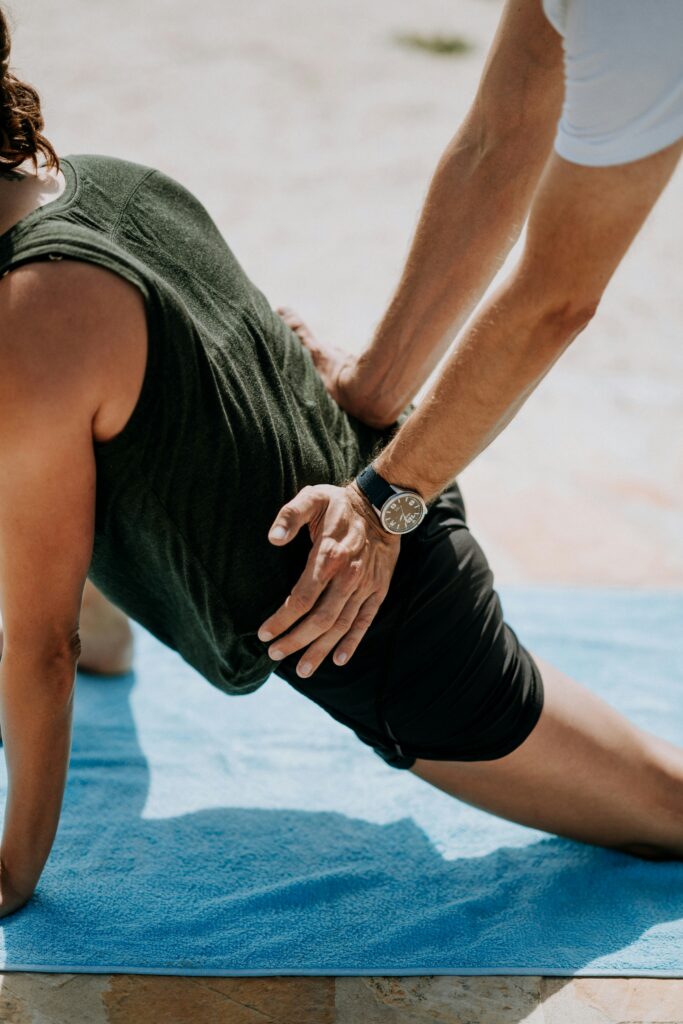
If you have lower back pain, there is a high chance the problem is not your back.
It’s your hips. Tight Hips Are Causing Your Lower Back Pain.
This is one of the most common patterns I see—and one of the most misunderstood.
People focus on where it hurts.
But in the body, the place of pain is often just the place of compensation.
The Real Problem Is Not Where You Feel It
Lower back pain feels like a back issue.
So people stretch their back.
Massage it.
Crack it.
Try to loosen it.
But in many cases, the lower back is not the problem.
It’s doing extra work because something else isn’t.
And very often, that “something else” is your hips.
What Sitting Does to Your Body
If you sit a lot—and most people do—your hips adapt.
Hip flexors shorten.
Glutes become inactive.
Your pelvis shifts forward.
This creates what’s called an anterior pelvic tilt.
From there, everything changes:
- Your lower back tightens
- Your core becomes less effective
- Your glutes stop supporting movement
So your lower back takes over.
And over time, it gets overloaded.
Why Your Back Is Always Tight
Your lower back is not randomly tight.
It’s working too much instead of stabilizing when your core should.
It’s supporting movement when your glutes should.
So it contracts.
Constantly.
That’s why stretching it feels good—but never solves the problem.
Because the workload never changes.
Stress Makes It Worse
There’s another layer most people ignore.
Stress.
When you are under pressure, your nervous system stays activated.
Your body prepares for action—even if you’re just sitting at a desk.
Where does that tension go?
Often into:
- hips
- lower back
- neck
Not because you “store emotions” in a mystical way.
But because your system stays in a state of constant low-level contraction.
And over time, that becomes your baseline.
The High Performer Pattern
If you:
- work a lot
- think a lot
- push through things
- rarely stop completely
Then your system is rarely fully relaxed.
You are either:
- active
- or mentally active
And your body reflects that.
Tight hips are often not just a mobility issue.
They are a lifestyle signal.
What Actually Fixes It
You don’t fix this by stretching your back.
You fix it by restoring balance in the system.
That means:
- activating your glutes
- stabilizing your core
- opening your hips
- reducing constant tension
And doing this consistently.
Not randomly.
Precision Over Effort
Most people try to solve this with more effort.
More stretching, workouts, random exercises.
But that’s not the answer.
The answer is precision.
Doing the right things.
In the right way.
Consistently enough for the system to change.
This Is Where Momentum Matters
Back pain from tight hips doesn’t disappear because of one good session.
It disappears when your body starts functioning differently every day.
That’s exactly what 100% Momentum is built for.
Small, targeted actions.
Applied consistently.
So your system actually shifts—instead of resetting back to the same pattern.
Tight Hips Are Causing Your Lower Back Pain – Final Thought
If your lower back hurts, don’t just treat your back.
Look at your hips, your patterns and how you move—and how you live.
Because once the system changes, the pain has no reason to stay.
Release the Pain fast
Inside 100% Momentum, I show how to:
- release tension fast
- break recurring patterns
- and have a system that actually works
Support Your System
Your body also needs the right fuel to recover and perform.
That’s why I personally use high-performance nutrition like IM8.